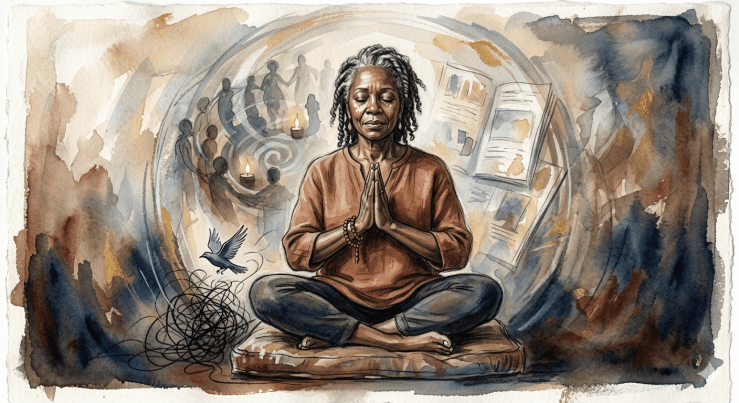
Last Wednesday, I woke up to a sweet, mid-week “how are you doing/what are you tending right now” message from a beautiful soul named Spirit. Attached was a YouTube link featuring a still image of a Black woman…spine tall and seated in the cross-legged position known as Sukhasana. Her palms were pressed together at her heart center in what most would call “prayer position,” all set to the soulful sounds of “Hey Queen” by Beautiful Chorus.
The first time I heard “Hey Queen,” I was about six months deep into the indescribable pain and impossible math of loss. 180 days without the physical presence of my son on this side of earth. I had been back at work a few months, performing the “functioning” version of myself (calculating the exact amount of air needed to say “hello” without shattering) in a workplace that was also transitioning.
I remember a meeting with new members shortly after I returned. We were wading through the shallow waters of elevator conversation…the weather, the weekend plans, the workday flow. Then came the introduction that felt like an extraction: a woman on the other side of the screen began to speak of her two beautiful children. I watched as joy skipped across her face and love vibrated in her voice as she named them. Memories of how my own “sonshine” used to light up my face and fill my heart created bodily responses I could not control.
My mouth began to feel like cotton. I knew the minute it was my turn to speak, it would sound like a frog was in my throat. Just as the floor became mine, my eyes (which I thought had been cried dry over those 4,300+ hours since I had last touched Norel) betrayed me. I was “this close” to an ugly cry that would have cried me a river across the 500 miles of fiber-optic cables between us. I totally dissociated after that point; two years later, I’m still not sure if I ever actually finished that introduction.
Around that time, my life felt like a series of explosions. I carried the weight of an inherited lie: that old, familiar warning that 80–90% of marriages are destined to fail after the death of a child. Shortly after Norel died, I remember saying to my husband that I didn’t want that to be us. At the time, I didn’t know it was a myth. I have since read that it was a misquoted line from a 1977 book, The Bereaved Parent, which confused “marital difficulty” with “divorce.”
But myths are often grounded in a felt truth. I could feel the physical friction of our mismatched grieving shifting the ground beneath our feet…the heavy silence in the house…and how he was turning outward and I was reverting inward.
Then came Grounded — an inaugural space in DC for Black female professionals to rediscover our “why.” On the final day, Shayna led us through a vision-setting exercise. As I flipped through magazines filled with images of big, beautiful, light-filled homes, “Hey Queen” began to play.
The tears didn’t just fall; they arrived.
I didn’t finish that vision board that day. I didn’t need to. The message was already etched in the atmosphere: I was being called to clear space. Not just in my house, but in my life and in my heart, so that I could finally breathe and, more importantly, receive.
Now, whenever that song finds me, whether through a text from a friend or a quiet moment in my car, I don’t hear it as a song. I hear it as a homecoming. I’ve stopped fighting the tears, and instead, I let them do the work of clearing the way.
We are never as alone as the grief tries to tell us we are. We are held by a lineage of survivors who knew how to build a blueprint out of thin air. Personally, I know that I (along with most Black people in America) come from a lineage of enslaved people who survived the Middle Passage, chattel slavery, Jim Crow and systemic oppression. They learned to navigate a new language in a new land while keeping their own spirits intact. They designed escape routes in the patterns of braids and cornrows, echoed directions in the rhythm of drumbeats, stitched maps into the fabric of quilts and organized/led far more rebellions and escapes than the history books would have you to believe. Despite the horrific racism and violence bestowed upon them, they still possessed the radical capacity to love and the audacity to experience joy.
I find comfort in knowing that I am here today, living and breathing, because of the prayers of those who came before me. I have absolutely no doubt that I am Still Standing and Still Stacey because of the strength and awesomeness of my ancestors—which now includes my son (and my brother…my father…all my grandparents…and a host of cousins, aunts and uncles).
Today, I’m leaning into the mantra. Not because I’ve “arrived,” but because I am still practicing the art of listening to my own voice and claiming the peace that already has my name on it.
Hey Queen. You are not alone.
Hey Queen. You can have whatever you dream.
Hey Queen. Listen to your own inner voice.
Hey Queen. You know what you want.
Join the Practice
To the one tending their own garden of grief or transition today, I would love for you to comment below or send me a direct message sharing one “anchor” (a song, a mantra, or a small ritual) that helps you clear space when the world feels too loud or the transition feels too heavy.
***
Stacey McAdoo, the 2019 Arkansas Teacher of the Year, brings over twenty years of experience advocating for traditionally underrepresented students and educators. Her relationship-based approach to education is featured in the award-winning Arkansas PBS docuseries Closing the Opportunity Gap and the course Coaching Self Expression: Go-In Poet.
As the founder of the Writeous Poets (a spoken word and youth advocacy collective) and an expert professional development facilitator, Stacey designs sessions centered on arts integration, equity, and empowerment. Currently, she serves as a professor at Reach University and the Executive Director for Teach Plus Arkansas, where she leads a policy fellowship that empowers educators to advocate for systemic change. She is also the host of the A Mile In My Shoes: The Walk & Talk Podcast.
 Still Stacey
I am in the rhythms of grieving over the loss of my mom on Feb. 26, 2026. I know it means I am just vulnerable to the love and and joy she brought to my life.
“It is the nature of grace always to fill spaces that have been empty.” Goethe
LikeLike
Thank you, Lisa, for commenting and sharing — especially so early and fresh in your grief…that was very vulnerable and brave.
LikeLike
Do you get your package?
LikeLike
Yes I got the books you sent. I so appreciate you for caring and reaching out. I hope you are enjoying the new community you have created.
Lisa
LikeLike