…a speech for United Women of Faith by stacey james mcadoo…
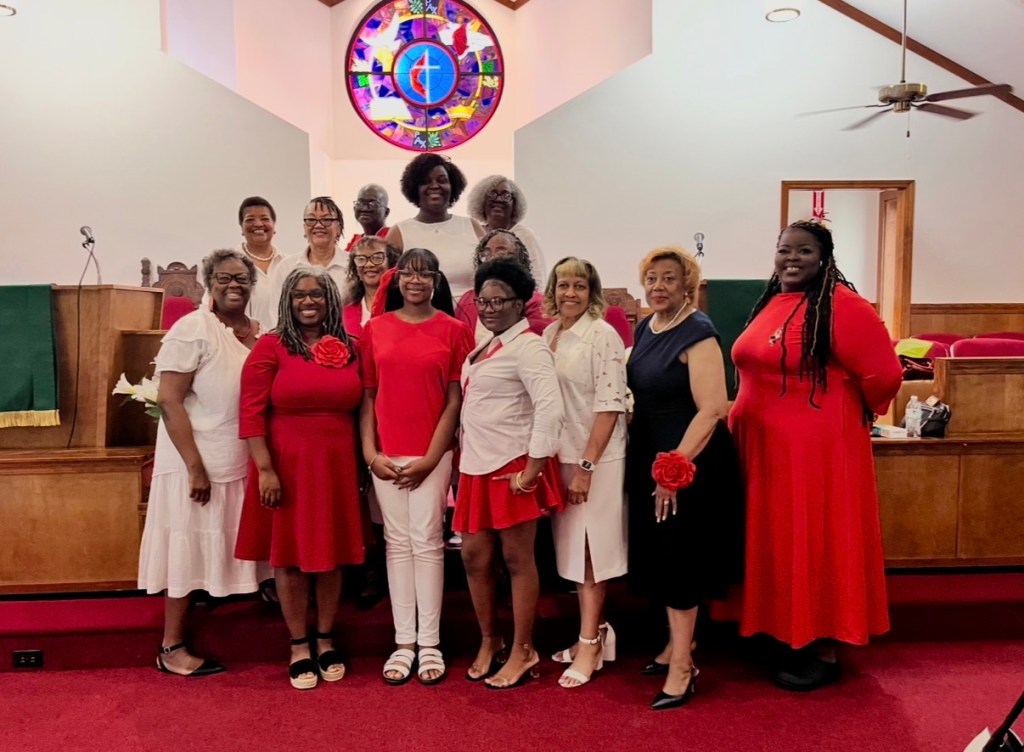
When I think about “church, church”…not the building but the people who gather and do the work to make it a church… I don’t think of or just see a congregation—I see a village. I see hands that hold people and things together and strong shoulders and loving hearts that have anchored one another through every season.
I love today’s theme of Mapping Our Way Forward: Divine Direction in the Valley. So much so, that had it been any other topic, I would have felt unqualified to be your guest speaker today. Primarily because I am currently unchurched, am not a bible scholar and you all are truly the first congregation that I’ve ever spoken to.
When we talk about “Mapping Our Way Forward,” we often imagine having a clear map spread out on a table, every turn marked, every stop planned. But if life has taught me anything, it’s that God rarely hands us a complete map. More often, He gives us just enough light for the next step.
Back in 2019, when I was serving as the Arkansas Teacher of the Year, I found myself standing in the halls of the United States Capitol. U.S. Representative Jahana Hayes, who had previously taught high school history and social studies in Connecticut and was named the 2016 National Teacher of the Year prior to her election to Congress, looked at us (though I felt it she was only looking at and talking to me) and shared those famous words: “Perhaps you were born for such a time as this.”
It’s a striking sentence and an awesome moment. It feels powerful when you’re standing under grand domes and holding titles. But what I’ve learned since then is that being called “for such a time as this” isn’t just for the high moments of victory. It is for the dark valleys, too.
Psalm 25:4–5 says: “Show me your ways, Lord, teach me your paths. Guide me in your truth…”
Notice what David is asking for here. He isn’t asking God for an easy road or a shortcut around pain. He is asking to be shown the way while he is in the middle of needing direction.
If we look at the women in God’s Word, we see that divine direction almost always starts when the ground beneath them shakes.
- Take Esther. She didn’t ask for a crisis or set out to be a hero. She was a young orphan elevated to a royal palace, suddenly facing a political decree meant to eliminate her people. She was terrified. Walking into the king’s inner court uninvited meant risking her life. But her cousin reminded her that her position wasn’t just a privilege—it was a purpose. Courage for Esther didn’t mean the absence of fear. It meant taking a breath, trusting God’s direction, and stepping forward when every instinct told her to run back.
- Then consider Ruth. Ruth knew the heavy, crushing weight of loss. Her husband died, leaving her with no financial safety net and a heart full of grief. Her mother-in-law, Naomi, told her to turn back to safety, but Ruth refused to let grief have the final word on her future. She declared, “Where you go I will go, and where you stay I will stay.” Ruth mapped her way forward one step at a time trusting that God’s guidance was hidden inside her quiet faithfulness.
Neither of these women had the whole map. And both of them had to walk paths they never would have mapped out for themselves. They didn’t have the blueprin, but they the courage to pray, “Show me your ways,” and keep moving.
***
If anyone here knows just a snippet of my story, then you know that death has frequented my family’s doorstep in ways that feel far too heavy for one heart to hold. I have lived through the murder of my father, the loss of only sibling and favorite brother Craig, and most recently my sonshine, Norel. I have lived through what I imagine what every daughter, sister and parent fears most. And, yet, I’m still standing.
Society often looks at people “surviving” and call it strength. On television or in books, resilience is portrayed as this neat, victorious thing…where someone goes through tragedy, pulls themselves up by their bootstraps, puts on a smile, and moves on seamlessly.
But real grief doesn’t look like that.
Grief is messy. And resilience isn’t about never crying, never breaking down, or having it all figured out. Resilience is simply waking up, breathing through the pain, and deciding to take another step forward—even when your hands are shaking. It is choosing to live in spite of surviving your biggest fear.
That is why I created Still Standing: The Practice. It wasn’t because I had solved grief or found a magical cure for loss. It was because I realized that healing isn’t meant to be done in isolation. I’ve made a conscious effort to make my healing practice public and invite others alongside me so that others would know that they don’t have to walk the valley alone.
Today, I want us to remind each other of that truth. I’m going to call out a sentence, and when I say, “And yet…” I want you to respond with “We are Still Standing!”
- When the storm rolls in and the path ahead is hidden… And yet…
(Congregation responds: “We are Still Standing!”) - When grief enters our homes and the heart breaks… And yet…
(Congregation responds: “We are Still Standing!”) - When the load gets heavy and the journey feels long… And yet…
(Congregation responds: “We are Still Standing!”)
When Psalm 25 asks God to “teach me your paths,” I believe one of God’s primary answers to that prayer is each other. God maps our way forward through community.
Our duty as a church, as United Women in Faith, and as neighbors isn’t to fix each other’s pain or offer easy platitudes when someone is suffering. Our duty is simply to be there. To sit in the quiet with one another. To say, “I see your pain, and you don’t have to carry it alone.”
Starting next month, I am partnering with the Central Arkansas Library System to facilitate a public space called Still Standing: Journeying Through Grief. It is a community grief circle where anyone carrying the weight of loss (of any kind because we all know that grief isn’t just about the physical loss of a loved one lone, it can about that the future that you dreamed you would have but won’t, the ending of a relationship, losing a pet, etc.) can come, sit, speak, or just listen.
Before I close, I want to ask two things of you today:
- Be gentle with yourself and others. If you are walking through a valley right now, know that asking God to show you the way doesn’t mean you have to see the end of the road today. Just ask for enough light for today.
- Help us build the bridge. If you know someone in our community who is carrying heavy loss—a neighbor, a coworker, a friend—tell them about these sessions at the library. Let’s make sure no one in our village feels like they have to navigate the dark by themselves.
We are all mapping our way forward. But praise God, we don’t have to walk the path alone. And yet…we are all still standing.
Thank you, and God bless you.
***
Stacey McAdoo, the 2019 Arkansas Teacher of the Year, has dedicated over twenty years to advocating for traditionally underrepresented students and educators. Her relationship-based approach to education is featured in the award-winning Arkansas PBS docuseries Closing the Opportunity Gap and her specialized course, Coaching Self-Expression: Go-In Poet.
As the founder of the Writeous Poets (a spoken word and youth advocacy collective) and an expert professional development facilitator, Stacey designs transformative sessions centered on arts integration, equity, and empowerment. She currently serves as a professor at Reach University and the national Managing Director of Learning & Development for Teach Plus. Additionally, she is the host of the A Mile In My Shoes: The Walk & Talk Podcast and the founder of Still Standing: The Practice, a community for resilient women who, to the world’s astonishment and surprise, continue to stand and thrive despite life’s most unimaginable challenges.

